


How to Transform Your Home: A Complete Guide to Planning, Designing, and Remodeling Your Space
Your home should make your life easier, not constantly remind you about the things that don't work.
Maybe the kitchen feels cramped. Maybe the bathroom is outdated. Perhaps your basement is little more than storage, or your home's layout no longer fits the way your family lives.
That is where remodeling can make a real difference.
But we believe a successful home remodel starts long before demolition begins. The goal isn't simply to make a home look newer. It's to solve problems, improve how the space works, and create something that continues to serve you for years.
And right now, homeowners have plenty of reasons to think carefully about remodeling.
The National Association of Home Builders reports that nearly half of owner-occupied homes in the U.S. were built before 1980, with a median age of about 41 years. At the same time, remodeling continues to represent a major part of the residential construction market.
So, how do you approach a remodel without getting overwhelmed?
We recommend starting with a plan.
What Does It Really Mean to Transform Your Home?

Home transformation doesn't necessarily mean knocking down walls or remodeling every room.
Sometimes, the biggest improvement comes from changing one part of the house that causes problems every day.
That could mean:
Opening up a poorly designed kitchen
Creating better bathroom storage
Finishing an unused basement
Improving lighting
Replacing worn flooring
Adding functional storage
Updating an outdated layout
Improving insulation and energy performance
Creating a more comfortable living area
Making the home easier to navigate as your needs change
In other words, we don't look at remodeling as simply replacing old materials with new ones.
We look at it as solving problems.
Start With What Isn't Working

Before choosing countertops, paint colors, flooring, or cabinets, ask a more important question:
What do we want this remodel to fix?
That question can completely change the direction of a project.
Maybe your kitchen has enough square footage but poor traffic flow. Maybe your basement is large but unusable. Maybe your bathroom has beautiful finishes but nowhere to store everyday items.
Write those problems down.
Then separate them into three categories:
Must fix: Problems affecting safety, structure, water, comfort, or daily function.
Should improve: Problems that make the home less convenient or enjoyable.
Would be nice: Cosmetic upgrades that aren't essential.
This simple exercise can help keep your budget focused on improvements that actually matter.
Don't Confuse More Space With Better Space
One of the biggest remodeling misconceptions is that homeowners always need more square footage.
Sometimes, they don't.
A better layout, built-in storage, improved lighting, or opening a room to an adjacent space can make an existing area feel significantly more useful.
That is why we recommend evaluating how your family moves through the home before deciding that an addition is the answer.
Which Areas of Your Home Should You Remodel First?

There isn't one universal answer.
The right starting point depends on your home's condition, your budget, and what you want to accomplish.
Still, some projects tend to be especially common. According to the NAHB's 2025 Remodeling Market Index survey, bathroom remodeling was the most common project among surveyed remodelers, followed by kitchen and whole-house remodeling.
The kitchen often becomes the center of the home.
A successful kitchen remodel can improve:
Workflow
Counter space
Storage
Lighting
Appliance placement
Seating
Entertaining space
But we don't recommend choosing finishes first.
Start with the way you cook, clean, entertain, and move through the room.
Bathrooms are another high-impact remodeling area.
Think beyond appearance.
A better bathroom can improve storage, lighting, ventilation, accessibility, and everyday comfort.
If you're remodeling for the long term, consider whether the space will continue working for you as your needs change.
An unfinished basement can represent a significant amount of unused space.
Depending on the home, it could become:
A family room
Home office
Guest area
Recreation space
Exercise area
Entertainment room
Additional storage
Before finishing a basement, however, we recommend addressing moisture and other underlying issues first.
There's little value in installing beautiful finishes over a problem that hasn't been solved.
Whole-Home Remodeling
Sometimes individual projects don't make sense because the problems are connected.
If the flooring, lighting, layout, kitchen, bathrooms, and other areas all need attention, a coordinated plan may produce a better result than remodeling one room at a time without considering the bigger picture.
Build Your Remodeling Plan Before You Build the Project

A remodeling project becomes much easier to manage when the major decisions happen before construction starts.
We recommend defining:
What isn't working
What you want to change
Your must-have improvements
Your realistic budget
Your preferred timeline
The materials and finishes that fit your lifestyle
Whether structural or permitting issues may be involved
This is also the point where you should think about how long you intend to stay in the house.
If you're planning to stay for another 15 or 20 years, your decisions may look very different from those of someone preparing to sell within two years.
How Much Does Home Remodeling Cost?

This is usually one of the first questions homeowners ask.
The honest answer is that there isn't one price that applies to every home.
The cost depends on the size and complexity of the project, labor, materials, structural changes, plumbing, electrical work, permits, demolition, site conditions, and the level of customization.
The larger remodeling market also changes over time. Harvard's Joint Center for Housing Studies reported in July 2026 that annual spending on home improvements and repairs is expected to reach roughly $519 billion through mid-2027, while year-over-year growth is projected to slow to 0.5% by the second quarter of 2027.
That matters because remodeling costs don't exist in a vacuum. Labor availability, material prices, housing activity, and broader economic conditions can all affect project pricing.
Don't Forget the Costs You Can't See
The visible part of a remodel is often the easiest part to budget.
The surprises can come from behind the walls.
Potential unexpected costs include:
Water damage
Structural repairs
Electrical upgrades
Plumbing problems
Outdated materials
Permit requirements
Subfloor repairs
Moisture problems
Additional demolition
Material delays
We recommend keeping a contingency reserve rather than putting every available dollar into finishes.
Design Around How You Actually Live

A beautiful room that doesn't function well is still a bad remodel.
Think about your daily routines.
Where do people enter the home?
Where do backpacks, shoes, coats, and packages go?
Where does the family gather?
Where do you prepare meals?
Where do you work?
Where do you need quiet?
These questions may seem simple, but they can influence much bigger design decisions.
Prioritize Function Before Finishes
We'd rather see a homeowner choose a practical layout with modest finishes than an expensive room that creates daily frustration.
Consider:
Traffic flow
Storage
Lighting
Furniture placement
Electrical outlets
Natural light
Cleaning and maintenance
Accessibility
Then choose finishes that support the design.
Think About Energy Efficiency During Remodeling

A remodel can also be an opportunity to improve comfort and energy performance.
The U.S. Department of Energy notes that insulation and air sealing are important parts of the building envelope and can reduce unwanted heat transfer. Windows also play a meaningful role in building energy performance.
That means certain remodeling decisions deserve attention beyond appearance.
Depending on the project, you may want to evaluate:
Insulation
Air sealing
Windows
Doors
Lighting
Heating and cooling systems
Ventilation
We don't recommend replacing something simply because it's old.
Instead, look at whether the improvement solves a real comfort, efficiency, durability, or maintenance problem.
Don't Ignore Structural Issues

This is one area where homeowners should slow down.
Removing a wall isn't always a cosmetic decision.
Some walls carry loads. Changing the layout may affect beams, columns, floors, ceilings, plumbing, electrical systems, or other structural components.
If you're considering a major layout change, determine what is involved before demolition begins.
When structural questions arise, the appropriate professional should evaluate them rather than relying on guesswork.
The same principle applies to older homes. Census data shows that older housing can carry higher improvement and maintenance needs, which makes evaluating the existing condition especially important before starting a major project.
Don't Forget Permits and Building Requirements

Some remodeling work requires permits, inspections, or compliance with local building requirements.
The exact requirements depend on the project and municipality.
Structural changes, electrical work, plumbing, additions, and other significant alterations may involve requirements that don't apply to simple cosmetic updates.
We recommend determining those requirements before construction begins.
That can prevent an expensive surprise later.
How to Choose a Remodeling Contractor

The contractor you choose can have as much impact on the project as the materials you select.
We recommend looking for:
Relevant remodeling experience
Proper licensing and insurance where required
Clear communication
Detailed written proposals
References and reviews
Real examples of completed work
Transparent payment terms
A clear project-management process
Written expectations for changes and unexpected conditions
Don't choose a contractor based solely on the lowest estimate.
Two proposals can look very different because they may include different materials, scopes of work, allowances, labor, or project responsibilities.
Instead, compare what you're actually getting.
What Does the Remodeling Process Look Like?

A well-planned remodel usually follows a progression like this:
Planning → Assessment → Design → Budget → Contract → Permits → Demolition → Construction → Finishing → Final Walkthrough
Each stage matters.
1. Planning
Define your goals and priorities.
2. Assessment
Evaluate the existing home and identify potential problems.
3. Design
Determine the layout, materials, finishes, and functional details.
4. Budgeting
Build a realistic project budget, including a reserve for unexpected conditions.
5. Contract
Make sure the scope, payment terms, responsibilities, and expectations are documented.
6. Construction
The physical transformation begins.
7. Final Walkthrough
Review the finished work, identify outstanding items, and make sure the project matches the agreed scope.
How Long Does a Remodel Take?

There's no reliable universal timeline.
A small cosmetic update may move quickly. A kitchen remodel can take longer. A whole-home project or structural renovation may require significantly more coordination.
Delays can come from:
Permit approvals
Material availability
Design changes
Hidden damage
Structural discoveries
Subcontractor scheduling
Weather
Client-requested changes
The best way to manage expectations is to discuss the schedule before work starts and establish how changes will affect it.
Common Remodeling Mistakes We See Homeowners Make

We've found that many remodeling problems don't start with construction.
They start with planning.
Mistake #1: Starting Without a Clear Budget
If you don't establish financial limits early, it's easy for the project to grow beyond what you intended.
Mistake #2: Choosing Looks Over Function
A room can look incredible and still be frustrating to use.
Mistake #3: Ignoring Problems Underneath the Surface
Covering water, structural, electrical, or plumbing problems doesn't make them disappear.
Mistake #4: Changing the Plan Constantly
Changes during construction can affect cost, schedule, and other parts of the project.
Mistake #5: Choosing the Cheapest Estimate
Price matters, but scope matters just as much.
Mistake #6: Trying to Do Everything at Once
A phased approach can sometimes make more financial and practical sense.
Should You Remodel for Yourself or Resale Value?
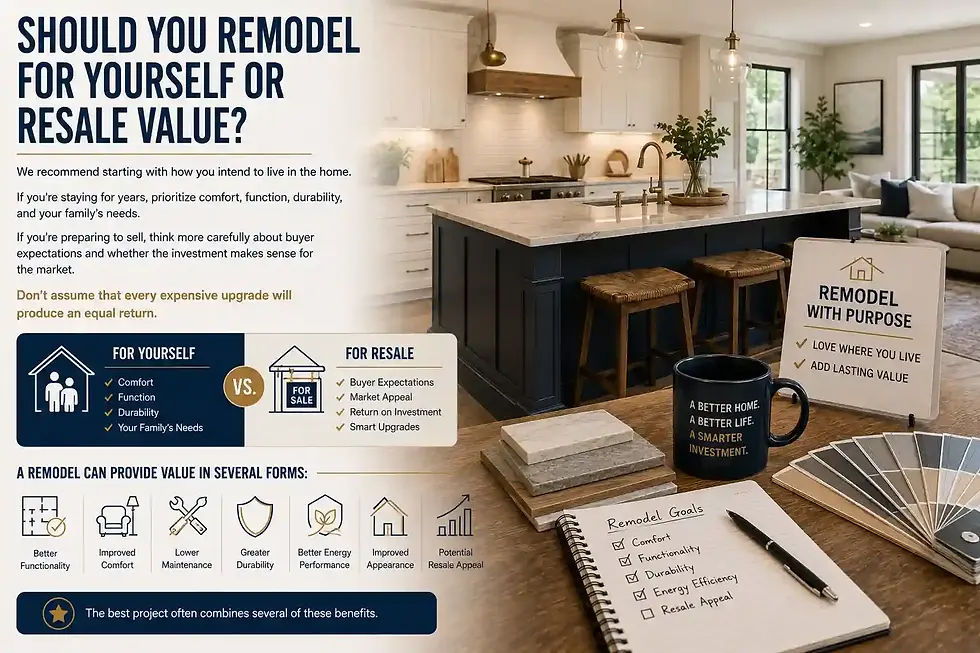
We recommend starting with how you intend to live in the home.
If you're staying for years, prioritize comfort, function, durability, and your family's needs.
If you're preparing to sell, think more carefully about buyer expectations and whether the investment makes sense for the market.
Don't assume that every expensive upgrade will produce an equal return.
A remodel can provide value in several forms:
Better functionality
Improved comfort
Lower maintenance
Greater durability
Better energy performance
Improved appearance
Potential resale appeal
The best project often combines several of these benefits.
Think About the Future, Too

A good remodel shouldn't only solve today's problems.
It should give you flexibility.
This matters particularly as homeowners get older.
The Census Bureau found that about 4 million households with an adult age 65 or older reported difficulty living in or using some features of their home. It also found that only about 40% of U.S. homes had basic aging-ready features such as a step-free entrance and a bedroom and full bathroom on the first floor.
That doesn't mean every homeowner needs to remodel for accessibility today.
It does mean that thoughtful remodeling can consider tomorrow's needs as well as today's.
Our Home Remodeling Checklist

Before starting your project, we recommend asking:
What problem are we solving?
What do we want the finished space to accomplish?
Which improvements are essential?
What is our realistic budget?
Have we included a contingency?
Are there structural concerns?
Will permits be required?
How will we use the space every day?
What materials fit our lifestyle?
How long can we realistically live through construction?
What happens if unexpected problems appear?
Who will manage the project?
What is included in the contract?
What happens when changes are requested?
How will the project benefit us long term?
If you can answer those questions before construction begins, you're already in a much stronger position.
Final Thoughts: The Best Remodel Solves the Right Problems
A successful home remodel isn't necessarily the biggest project or the most expensive one.
It's the project that makes sense for your home.
That means identifying what isn't working, setting realistic priorities, creating a practical budget, thinking through the design, addressing structural and building concerns, and choosing the right professionals for the work.
The remodeling market continues to evolve, but the basic principle hasn't changed:
homeowners want their existing homes to work better for their lives. Current NAHB research shows continued strength in remodeling, with bathroom, kitchen, and whole-house projects among the most common remodeling work.
At Burrini and Sons Contracting, we believe remodeling should begin with listening—not demolition.
Our goal is to understand what isn't working in your home, help you think through the options, and create a remodeling plan that balances function, quality, budget, and long-term value.
Because transforming your home isn't really about making it look different.
It's about making it work better for you.

Comments