


Best Basement Flooring for NJ Homes: LVP, Tile, Carpet or Engineered Wood?
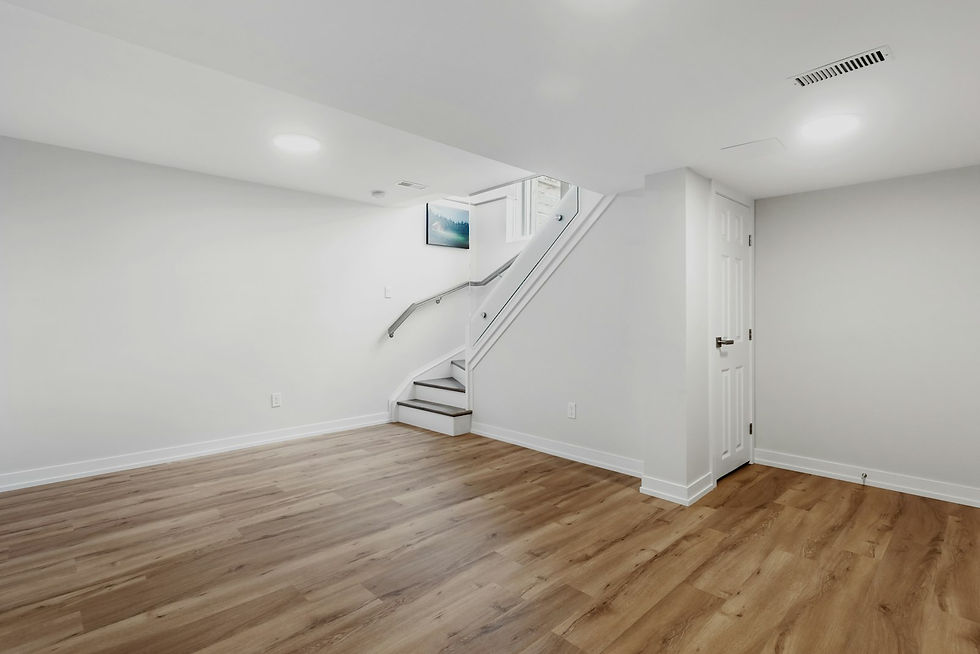
Choosing basement flooring sounds simple until you remember one thing: a basement is not the same as the rest of your house.
The floor sits on or near a concrete slab. Humidity can be higher. Moisture can move through concrete even when you have never seen standing water. And if your basement has had leaks or flooding before, the flooring you choose becomes even more important.
That is why we do not recommend choosing a basement floor based on looks alone.
For many finished basements in Morris County, luxury vinyl plank, especially rigid-core LVP, gives homeowners one of the best combinations of appearance, durability and easy maintenance. Tile is an excellent choice when moisture resistance is the priority. Carpet works well when comfort matters and the basement stays consistently dry. Engineered wood can create a premium look, but we are more selective about where we use it below grade.
The best choice depends on your basement.
Let's compare the options.
Best Basement Flooring Options at a Glance
If you want the short answer, start here.
Flooring | Moisture Tolerance | Comfort | Maintenance | Best For |
LVP / Rigid-Core Vinyl | Very good | Good | Easy | Family rooms, offices, playrooms |
Porcelain or Ceramic Tile | Excellent | Hard/cool | Easy | Bathrooms, laundry areas, wet-risk spaces |
Carpet | Low to moderate | Excellent | Moderate | Dry media rooms, bedrooms, playrooms |
Engineered Wood | Moderate | Good | Moderate | Dry, climate-controlled finished basements |
If we had to recommend one starting point for the average finished basement, we would usually look at rigid-core LVP first.
But there is an important step before choosing any of these.
Before You Pick a Floor, Make Sure the Basement Is Dry
This is where a lot of flooring projects go wrong.
Installing a moisture-resistant floor does not fix a moisture problem.
If your basement has water intrusion, drainage problems, visible leaks, repeated condensation or unusually high humidity, those issues should be addressed before the finished flooring goes down.
That is especially important in New Jersey. The New Jersey Department of Environmental Protection says precipitation intensity in the state is increasing above historical trends, which is increasing flash-flood risk for inland properties.
That does not mean every Morris County basement is going to flood.
It does mean we should take moisture seriously instead of assuming a basement is dry because there is no water on the floor today.
Look for warning signs such as:
Previous flooding or water intrusion
Musty odors
White mineral deposits on concrete
Damp areas near foundation walls
Condensation
Cracks that have leaked
Repeated sump-pump activity
High indoor humidity
A finished floor should be the last layer of a good basement system, not something used to hide a problem underneath it.
Basement Humidity Matters Too
You do not need standing water to have a moisture problem.
Humidity matters.
The U.S. Environmental Protection Agency recommends keeping indoor relative humidity below 60%, ideally between 30% and 50% when possible.
In a basement, a dehumidifier may be part of maintaining a comfortable finished space, especially during warmer, humid months.
Once we know the basement is suitable for flooring, we can start comparing materials.
1. Luxury Vinyl Plank: Our Best All-Around Basement Flooring Option
Luxury vinyl plank, or LVP, has become one of the most popular choices for finished basements.
There is a good reason.
It gives homeowners the appearance of hardwood without many of the moisture concerns associated with real wood. It is easy to clean, comfortable enough for everyday living and available in a huge range of wood and stone styles.
Rigid-core versions, including SPC flooring, can be particularly useful over basement slabs because the dense core creates a stable surface.
We like LVP for:
Basement family rooms
Home offices
Playrooms
Entertainment rooms
Finished hallways
Multi-purpose spaces
It is also a practical choice for families with children or pets because everyday cleaning is simple.
Is LVP Waterproof?
This is where the wording can get confusing.
Many vinyl products are marketed as waterproof, and the plank itself may tolerate water extremely well.
But that does not mean installing LVP makes your basement waterproof.
Water can still move around the perimeter, through joints or underneath the flooring. Fine Homebuilding's 2026 basement-flooring guidance notes that persistent water vapor can even cause LVP to cup or distort.
So our rule is simple:
Fix the water problem first. Choose the flooring second.
Can LVP Go Directly Over a Concrete Basement Floor?
Often, yes.
But the concrete needs to meet the flooring manufacturer's requirements.
That means checking:
Moisture
Flatness
Cracks
Surface condition
Required vapor protection
Approved underlayment
Concrete basement floors are rarely perfectly flat. Fine Homebuilding notes that flooring manufacturers often specify very tight flatness tolerances, so high spots may need grinding and low areas may need patching or leveling before flooring is installed.
Skipping that preparation can lead to movement, uneven joints or premature flooring problems. That prep work is a standard part of our floor installation services.
2. Porcelain or Ceramic Tile: Best for High-Moisture Areas
If moisture resistance is your top concern, tile is hard to beat.
Porcelain and ceramic tile do not swell the way wood-based flooring can when exposed to moisture.
That makes tile a strong option for:
Basement bathrooms
Laundry rooms
Utility areas
Wet bars
Entry areas
Basements with a higher potential for incidental water
Tile is also durable and easy to clean.
The downside?
It can feel hard and cold underfoot.
That may not bother you in a bathroom or laundry room. It can be less appealing in a basement family room where people spend hours watching movies or where children play on the floor.
When Would We Choose Tile Over LVP?
We would lean toward tile when water exposure matters more than warmth or softness.
For example, a basement bathroom may make much more sense with porcelain tile installation than carpet or engineered wood.
Tile can also work well with radiant floor heating if the project is designed for it.
Like LVP, however, tile still requires proper slab preparation. Existing cracks and excessive moisture cannot simply be ignored because tile itself is water resistant.
3. Carpet: Best for a Warm, Comfortable Basement
There is one area where carpet easily beats the other options.
Comfort.
If you are turning your basement into a media room, guest room or children's playroom, carpet creates a warmer and quieter environment.
It also helps soften a space that may otherwise feel hard because of concrete walls and floors.
We like carpet for:
Basement bedrooms
Home theaters
Playrooms
Family rooms
Gaming areas
But there is a condition:
The basement needs to stay dry.
If a basement has a history of repeated water problems, wall-to-wall carpet would not be our first recommendation.
Carpet and padding can hold moisture, which makes cleanup after a water event much more difficult.
What About Carpet Tiles?
Carpet tiles can be worth considering in certain basements.
They give you some of the warmth and sound control of traditional carpet, while individual sections can be replaced if one area becomes damaged.
That does not make them waterproof, but the modular design may make repairs easier.
4. Engineered Wood: Best for a Premium Look in a Dry Basement
What if you really want real wood?
We would look at engineered wood before solid hardwood for a basement.
Engineered wood is constructed in layers, which generally makes it more dimensionally stable than solid hardwood when temperature and humidity change.
It can create a beautiful finished basement that feels more like the main level of the home.
We would consider engineered wood for:
Finished home offices
Guest suites
Upscale entertainment spaces
Consistently dry, conditioned basements
But engineered wood is not waterproof.
If moisture conditions are questionable, we would rather use a quality LVP with a realistic wood appearance.
Fine Homebuilding similarly recommends engineered wood over natural solid hardwood when a real wood-grain floor is wanted below grade, while noting that vinyl and tile provide greater moisture resistance.
LVP vs. Tile vs. Carpet vs. Engineered Wood: Which One Wins?
Here's how we would break it down.
Your Priority | Our Starting Recommendation |
Best all-around basement flooring | LVP |
Highest moisture tolerance | Porcelain tile |
Warmest floor | Carpet |
Softest floor | Carpet |
Real wood appearance | Engineered wood |
Lowest maintenance | LVP or tile |
Basement bathroom | Tile |
Family room | LVP or carpet |
Home office | LVP or engineered wood |
Children's playroom | LVP or carpet |
Basement with previous flooding | Solve moisture first, then consider tile or suitable vinyl |
Notice that we did not pick the same flooring for every room.
That is intentional.
A basement does not have to use one material everywhere.
A finished basement could have LVP through the main living area, tile in the bathroom and carpet in a media room. We walk through layouts like that in our post on finishing a Chester Township basement instead of building an addition.
The layout and use of the space should help drive the decision.
What Is the Best Flooring Over a Concrete Basement Floor?
For most homeowners, this is the real question.
A concrete slab changes the installation process.
Before covering it, we want to know:
Is it dry?
Is it flat?
Are there cracks?
Is there a vapor barrier or moisture-control system?
What does the flooring manufacturer require?
Older basement slabs deserve extra attention.
Fine Homebuilding notes that modern residential codes began requiring vapor retarders under basement slabs in the early 2000s, while many older homes may not have that same separation between the concrete and soil below.
That is why we do not assume two concrete basement floors should be treated exactly the same.
Do You Need a Basement Subfloor?
Sometimes. Not always.
A subfloor can:
Add warmth
Create a more comfortable finished floor
Provide a better installation surface
Help accommodate certain flooring systems
Provide space for specific moisture-management products
But adding a subfloor also raises the finished floor height.
That affects doors, stairs, transitions, baseboards and sometimes ceiling-height considerations.
The right answer depends on the slab and the flooring product.
Waterproof vs. Water-Resistant Basement Flooring
Here is a distinction every homeowner should understand.
A waterproof flooring product does not create a waterproof basement.
The flooring may resist water.
The structure underneath it can still get wet.
Water may travel underneath a floating floor. Moisture may enter through foundation walls. A sump pump can fail. A plumbing line can leak.
This is why we focus on the entire basement before focusing on the finished surface.
If there is an active water problem, the solution starts with drainage, waterproofing or repairs, not a new box of vinyl planks.
Best Basement Flooring Based on How You Use the Room
Family Room
Our first choice would usually be LVP. It is durable, easy to clean and works with many decorating styles.
Home Theater
Carpet deserves serious consideration because it feels warm and helps absorb sound.
Children's Playroom
Both LVP and carpet work. Choose LVP when spills and cleanup are the bigger concern. Choose carpet when softness is the priority and the basement is reliably dry.
Home Office
LVP works for most offices. Engineered wood can give a higher-end appearance in a dry, climate-controlled basement.
Basement Bathroom
We would usually recommend porcelain or ceramic tile.
Laundry Room
Tile or suitable vinyl makes more sense than carpet or engineered wood.
Home Gym
LVP can work, but dedicated rubber flooring may be a better choice under heavy exercise equipment.
What Does Basement Flooring Cost?
There is no useful one-price answer because preparation can change the project significantly.
A basement that is already flat, dry and ready for flooring is different from one requiring:
Old-floor removal
Crack repairs
Concrete grinding
Floor leveling
Moisture mitigation
Subfloor installation
New baseboards
Transitions
Stair work
This Old House's updated 2026 guide lists vinyl plank and engineered wood among several basement options and shows how material pricing varies significantly between flooring categories.
For a Morris County project, we recommend getting a quote based on the actual basement rather than relying on a national per-square-foot number. If flooring is part of a bigger project, our guide to what a basement remodel costs in Morris County puts it in context.
The condition of the concrete can matter just as much as the flooring you choose.
What Flooring Should You Avoid in a Damp Basement?
The bigger issue is not finding a material that can tolerate an unresolved problem.
It is fixing the problem.
That said, we would be cautious about:
Solid hardwood: Wood naturally expands and contracts with moisture and humidity, making below-grade installation risky.
Traditional laminate: Some products contain wood-based cores that can swell when exposed to water.
Wall-to-wall carpet in a damp basement: It can trap moisture and make cleanup difficult.
Engineered wood in a basement with recurring water problems: It is more stable than solid hardwood, but that does not make it waterproof.
When moisture risk is high, tile and appropriate vinyl products generally give homeowners more forgiving options.
Our Recommendation for Morris County Basements
If you want one answer, rigid-core LVP is our best all-around starting point for many finished Morris County basements.
It offers a strong combination of:
Moisture tolerance
Easy cleaning
Durability
Wood-look designs
Comfortable everyday use
Reasonable maintenance
For bathrooms and higher-moisture spaces, we would lean toward tile.
For a dry media room or bedroom where warmth matters most, carpet can still be a great choice.
And if you want genuine wood underfoot, engineered wood can work beautifully when moisture and humidity are under control.
The key is choosing the floor after understanding the basement. For more on matching flooring to each room upstairs too, see choosing the right flooring for your home.
Planning Basement Flooring in Morris County, NJ?
At Burrini & Sons Contracting, we look beyond the flooring sample.
Our flooring work includes subfloor preparation, surface leveling and moisture-barrier considerations, along with installation of materials such as luxury vinyl, tile and carpet. Our team has 45 years of hands-on flooring installation and repair experience.
That preparation matters even more in a basement.
Whether you are replacing an old floor or finishing the entire lower level with our basement remodeling team, the goal is to create a space that looks good and holds up over time.
If you are planning a basement project in Morris County, we can help you choose a flooring system that fits the condition of your basement, your budget and the way your family plans to use the space. Request a free quote.
A beautiful floor matters.
But a floor installed over the right foundation matters even more.
Frequently Asked Questions
What is the best flooring for a basement?
For many finished basements, we recommend rigid-core luxury vinyl plank because it balances moisture tolerance, appearance, durability and easy maintenance. Tile may be a better choice where water resistance is the top priority.
What is the best waterproof flooring for a basement?
Porcelain tile provides excellent water resistance. Many vinyl products also have waterproof or highly water-resistant cores. However, no flooring material can fix an active basement water problem.
Can LVP be installed directly over concrete?
Often, yes. The concrete needs to be dry, flat, clean and suitable under the flooring manufacturer's installation instructions. Some installations also require specific vapor barriers or underlayments.
Do I need a vapor barrier under basement flooring?
It depends on the flooring system, the slab and the manufacturer's requirements. Older basement slabs may need more moisture-control consideration than newer construction.
Is carpet a good choice for a basement?
Carpet can be excellent in a consistently dry basement, especially for bedrooms, playrooms and media rooms where warmth and comfort matter. We would avoid it in a basement with unresolved moisture problems.
Can engineered wood be installed in a basement?
Yes, engineered wood can be appropriate in some dry, climate-controlled basements. It is generally more stable than solid hardwood, but it still needs protection from excessive moisture.


Comments